
We are vehicle dealers, we sell export-ready cars from Dubai. We do not handle shipping. We can recommend trusted forwarders on request.
Buy a car in Dubai, get it de-registered, pass JEVIC inspection, book a RoRo or container ship from Jebel Ali Port, prepare your documents (Bill of Lading, export certificate, original logbook), then clear customs at your African destination port. Total cost ranges from $800 to $2,500 for shipping alone. Rules differ by country — Kenya allows cars up to 8 years old, Nigeria up to 10–12 years, and Tanzania has no hard age limit but charges higher tax on older cars.
Why Dubai Is the World’s Biggest Used Car Exporter to Africa
Dubai did not become the number one car export hub. It earned that spot because of a simple set of reasons that make sense for every African buyer.
First, there are no import taxes in Dubai. Cars come in from Japan, the USA, Germany, and Korea — all tax-free. That keeps prices low from the start. Second, Dubai cars come in GCC (Gulf Cooperation Council) specs, which means they are built for hot weather, rough roads, and long distances. Those are the same conditions found across Africa.
Third, Dubai sellers work fast. You can find a car, pay for it, and have it on a ship within two weeks. Few places in the world can match that speed.
Finally, Dubai is physically close to East African ports. A ship from Jebel Ali to Mombasa takes about 7 to 10 days. That is much faster than shipping from Europe or the USA.
At Al Rawnaq Motors, we have been helping buyers across Africa find, inspect, and ship quality used cars from Dubai for years. We know every step of this process, and this guide shares everything we have learned.
Top 10 African Markets for Dubai Used Cars
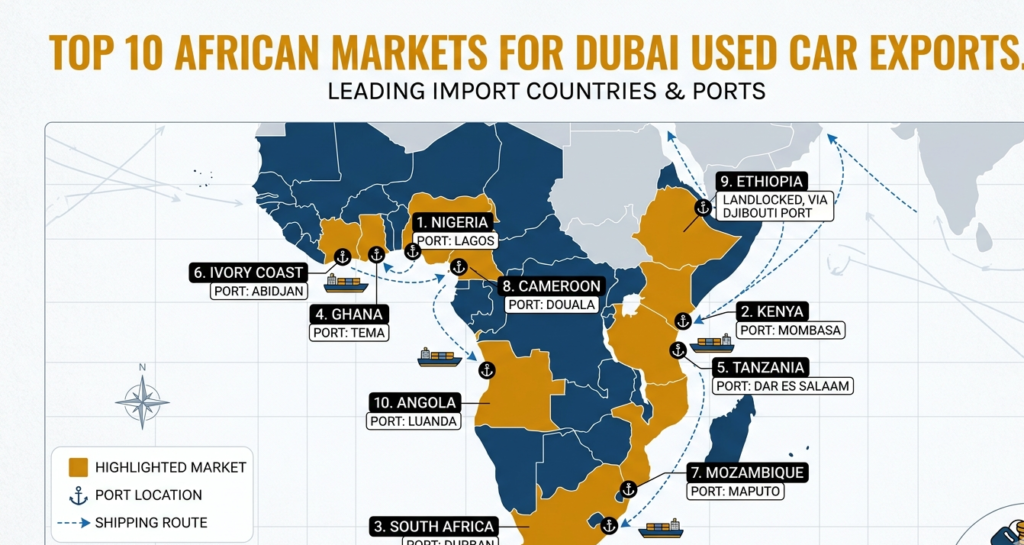
Not every African country imports cars the same way. Here are the top 10 markets and what makes each one special.
1. Kenya — Mombasa Port
Kenya is one of the biggest buyers of used cars from Dubai. The Port of Mombasa handles thousands of vehicles every month. Toyota Hilux, Toyota Land Cruiser, and Toyota Prado are top sellers here.
Key rules for Kenya (2026):
- Only right-hand drive (RHD) vehicles
- 8-year age limit — cars must be registered from January 1, 2019, or later
- KEBS/JEVIC inspection required before shipping — every car must pass a pre-shipment roadworthiness inspection
- Certificate of Roadworthiness (CoR) from QISJ needed
- Import duty: 25% of CIF value + 20% excise duty + 16% VAT + 2% IDF
Shipping time from Dubai: 7–10 days (RoRo)
2. Tanzania — Dar es Salaam Port
Tanzania is a fast-growing market with slightly more flexible rules than Kenya. Cars under 8 years old get the best tax rates. Over 10 years old means a higher duty.
Key rules for Tanzania:
- Right-hand drive preferred
- No hard age ban, but older cars face an extra tax
- 25% import duty + 10–20% VAT on CIF value
- Roadworthiness test at the port is required
- Register with the Tanzania Revenue Authority (TRA) and use their UMVVS tool to estimate duties before you buy
Shipping time from Dubai: 10–14 days (RoRo)
3. Nigeria — Lagos Tincan Port & Apapa Port
Nigeria is West Africa’s largest car market. Nigerians call used imported cars “tokunbo” — a word that means “from overseas.” The Lagos Tincan Island Port and Apapa Port handle most of the traffic.
Key rules for Nigeria:
- Left-hand drive (LHD) cars only
- 10-year age limit in 2026 — cars from 2015 or newer only
- SONCAP approval needed
- Form M, PAAR, VIN Valuation Report required
- Import duty: 35% + 35% levy + 7.5% VAT = roughly 70–90% of CIF value
Shipping time from Dubai: 18–22 days (RoRo)
4. South Africa — Durban Port
South Africa has the most developed car market on the continent. Buyers here often look for luxury cars, SUVs, and clean sedans from Dubai.
Key rules:
- Right-hand drive only
- Vehicles must meet NRCS (National Regulator for Compulsory Specifications) standards
- Customs duty around 25–40%, depending on engine size
- Detailed inspection on arrival
Shipping time from Dubai: 12–16 days
5. Ghana — Tema Port
Ghana is a growing market where Toyota and Hyundai models from Dubai are in high demand. The government allows both new and used car imports with fairly clear rules.
Key rules:
- No strict age limit, but older cars pay more duty
- Destination inspection required (GSIS)
- Import duty around 20–35%
- Both LHD and RHD cars are allowed
Shipping time from Dubai: 20–25 days
6. Uganda — Via Mombasa Port (Inland)
Uganda does not have a seaport, so all cars come through Mombasa, Kenya, and then travel overland. This adds cost and time but does not stop demand.
Key rules:
- Right-hand drive only
- 15-year age limit (more lenient than Kenya)
- Overland transport from Mombasa adds $300–$600
Shipping time from Dubai: 7–10 days sea + 3–5 days road
7. Zambia — Via Durban (Inland)
Zambia is a landlocked country that relies heavily on Durban Port in South Africa. Toyota Hilux and Land Cruiser models from Dubai are very popular here.
Key rules:
- Right-hand drive only
- 10-year age limit
- Import duty around 25–30%
- Overland cost from Durban: $500–$800
8. Zimbabwe — Via Durban or Beira Port
Zimbabwe has one of the most active used car markets in Southern Africa. Dubai cars are popular because of their durability and low mileage.
Key rules:
- Right-hand drive only
- 10-year age limit
- Import duty is roughly 40% of CIF
- Cars must pass the Zimbabwe traffic inspection on arrival
9. Ethiopia — Djibouti Port (Inland)
Ethiopia does not use its own coast much. Most cars come through Djibouti Port and travel overland. The market is growing fast with a young population hungry for vehicles.
Key rules:
- Left-hand drive
- Age limit: 8 years
- Import duty: roughly 35–50%
- Overland from Djibouti: $200–$400
10. Mozambique — Maputo Port & Beira Port
Mozambique is a growing market for used cars, especially trucks and pickups. Dubai is an increasingly popular source because of the price advantage.
Key rules:
- Right-hand drive
- Flexible age limits, but older cars face higher duties
- Import duty: 20–30%
Shipping Costs: Dubai to Africa (2026 Price Guide)
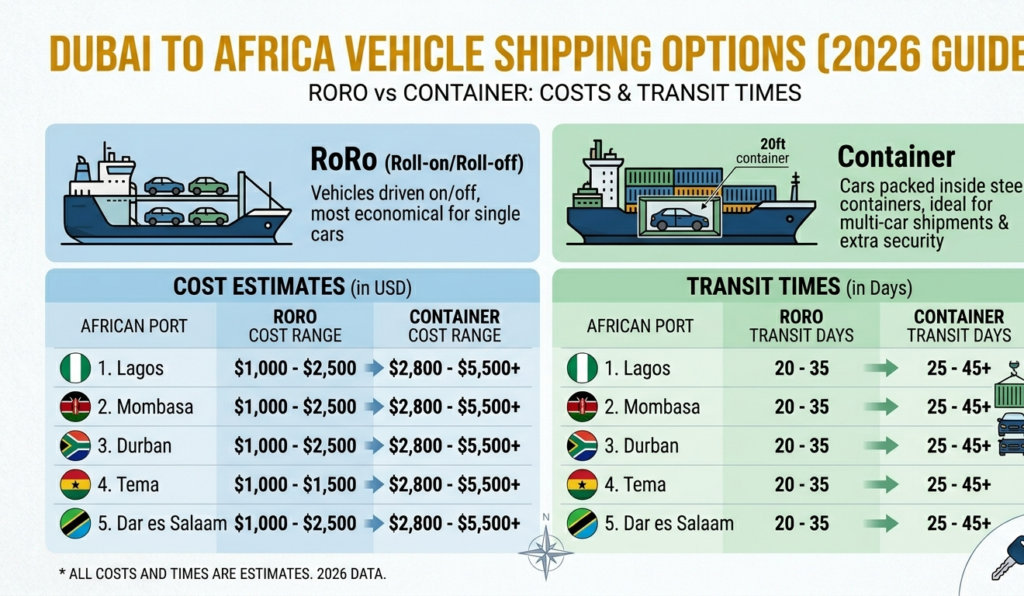
One of the first questions every buyer asks is: ” How much does shipping cost? Here is a clear breakdown.
RoRo vs Container Shipping — Which One Should You Pick?
RoRo (Roll-on/Roll-off) means the car is driven onto the ship and driven off at the other end. It is cheaper and faster. It is perfect for standard cars that are in working condition.
Container shipping means your car is loaded into a steel box container. It costs more, but gives better protection. It is the right choice for luxury cars, SUVs, or when you want to pack some personal items alongside the vehicle.
| Destination Port | RoRo Cost (USD) | Container Cost (USD) | Transit Time |
| Mombasa, Kenya | $800 – $1,200 | $1,400 – $2,000 | 7–10 days |
| Dar es Salaam, Tanzania | $900 – $1,500 | $1,500 – $2,500 | 10–14 days |
| Lagos Tincan, Nigeria | $1,200 – $1,800 | $1,800 – $2,800 | 18–22 days |
| Durban, South Africa | $1,000 – $1,600 | $1,600 – $2,400 | 12–16 days |
| Tema, Ghana | $1,200 – $1,800 | $1,800 – $2,600 | 20–25 days |
Prices are estimates for a standard sedan or SUV. Pickup trucks and large vehicles may cost more.
What Is Included in the Shipping Cost?
When a shipping agent quotes you a price, this is what is usually included:
- Loading at Jebel Ali Port
- Sea freight to the destination port
- Basic marine insurance
What is usually not included:
- Export plates and de-registration fees in Dubai ($50–$150)
- Port handling and storage at the destination
- Customs clearance agent fee ($100–$400)
- Import duty and taxes (varies widely)
- Inland transport from the port to your city
Always ask your agent for a full breakdown so you are not surprised later.
The JEVIC Inspection: What It Is and Why It Matters
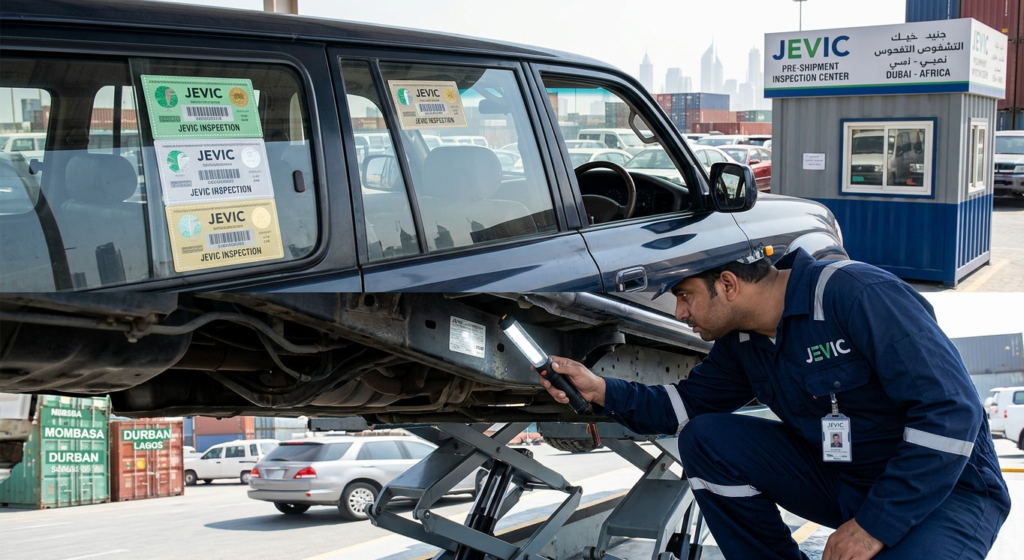
JEVIC stands for Japan Export Vehicle Inspection Center. Even though it started in Japan, JEVIC also operates in Dubai and the UAE. It is one of the approved inspection bodies for used cars going to Kenya and several other African countries.
Who needs JEVIC?
If you are sending a car to Kenya, JEVIC or QISJ (Quality Inspection Services Inc.) inspection is mandatory. KEBS (Kenya Bureau of Standards) will not accept a car without a valid Certificate of Roadworthiness (CoR) from one of these bodies.
What does JEVIC check?
- Engine condition and mileage accuracy
- Chassis and body damage
- Brake and light systems
- Safety features (airbags, seatbelts)
- Emission levels
How much does it cost?
JEVIC inspection in Dubai costs approximately $100–$250, depending on the car. It takes 1–3 days to get the certificate.
Always book your JEVIC inspection before finalizing your shipping date. Inspection delays can delay your shipment by weeks.
Step-by-Step: How to Export a Used Car from Dubai to Africa
Here is the full process explained simply.
Step 1 — Choose the Right Car
Pick a car that matches your country’s rules. Check the age limit, whether your country needs RHD or LHD, and whether the engine size fits local fuel prices. Popular safe choices for Africa include the Toyota Hilux, Toyota Land Cruiser, Nissan Patrol, Toyota Prado, and Toyota Hilux.
Step 2 — Buy from a Trusted Dealer
Work with a licensed Dubai dealer who has experience in African exports. They should give you the original logbook (not just an export certificate), full vehicle history, and a real invoice.
Important: Kenya Revenue Authority (KRA) does not accept a Dubai Police export certificate as a substitute for the original logbook. Always secure the original logbook before shipping.
Step 3 — De-register the Car
The car must be deregistered with the Roads and Transport Authority (RTA) in Dubai. You also apply for export plates, which are valid for 15–30 days.
Step 4 — Get the Pre-Shipment Inspection
Book JEVIC or QISJ inspection (for Kenya and other KEBS-regulated markets). For other countries, check with your clearing agent which body is accepted.
Step 5 — Book Your Shipment
Choose between RoRo or container shipping. Book with a licensed freight forwarder at Jebel Ali Port (Dubai’s main port). Get your Bill of Lading once the car is loaded.
Step 6 — Prepare Your Documents
You will need document for export including:
- Original vehicle logbook
- Bill of Lading
- Export certificate / de-registration document
- Certificate of Roadworthiness (CoR)
- Commercial invoice
- Packing list
- Your passport copy
Step 7 — Clear Customs at Your Destination Port
Work with a local licensed clearing agent at your African port. They will handle customs entry, pay duties on your behalf, and release the car to you.
Customs Rules & Age Limits by Country (Quick Reference Table)
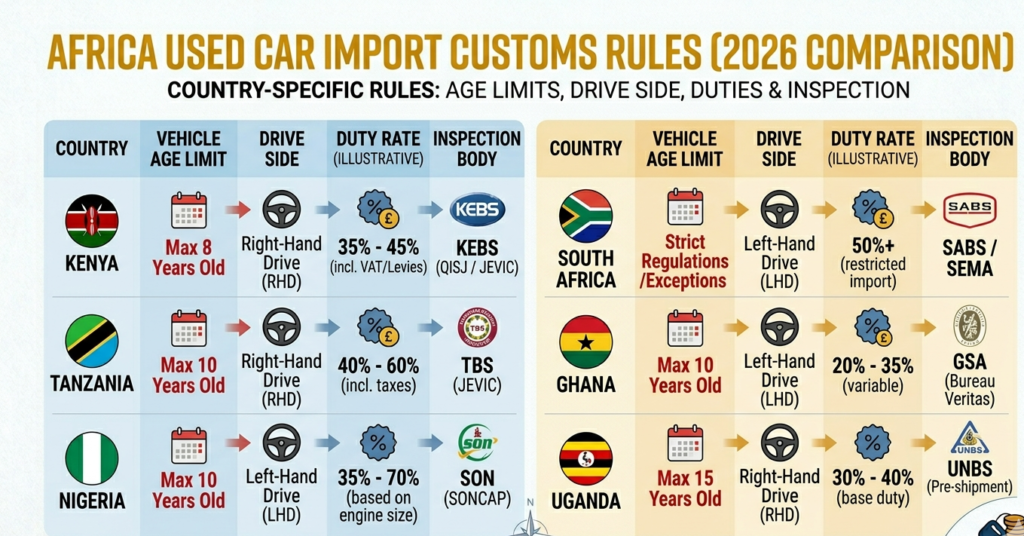
| Country | Age Limit | Drive Side | Approx. Total Duty | Inspection Required |
| Kenya | 8 years (2019+) | RHD | 45–60% of CIF | JEVIC / QISJ (CoR) |
| Tanzania | No hard limit (8 yrs recommended) | RHD | 40–55% of CI | Roadworthiness test at the port |
| Nigeria | 10 years (2015+) | LHD | 70–90% of CIF | SONCAP (SON) |
| South Africa | No strict limit | RHD | 25–40% of CIF | NRCS on arrival |
| Ghana | No strict limit | RHD/LHD | 20–35% of CIF | GSIS |
| Uganda | 15 years | RHD | 25–35% of CIF | Via Mombasa rules |
| Zambia | 10 years | RHD | 25–30% of CIR | Local inspection |
| Zimbabwe | 10 years | RHD | ~40% of CIF | Local inspection |
| Ethiopia | 8 years | LHD | 35–50% of CIF | Local inspection |
All rates are estimates. Always confirm with your clearing agent before buying.
Most Popular Cars to Export from Dubai to Africa (2026)
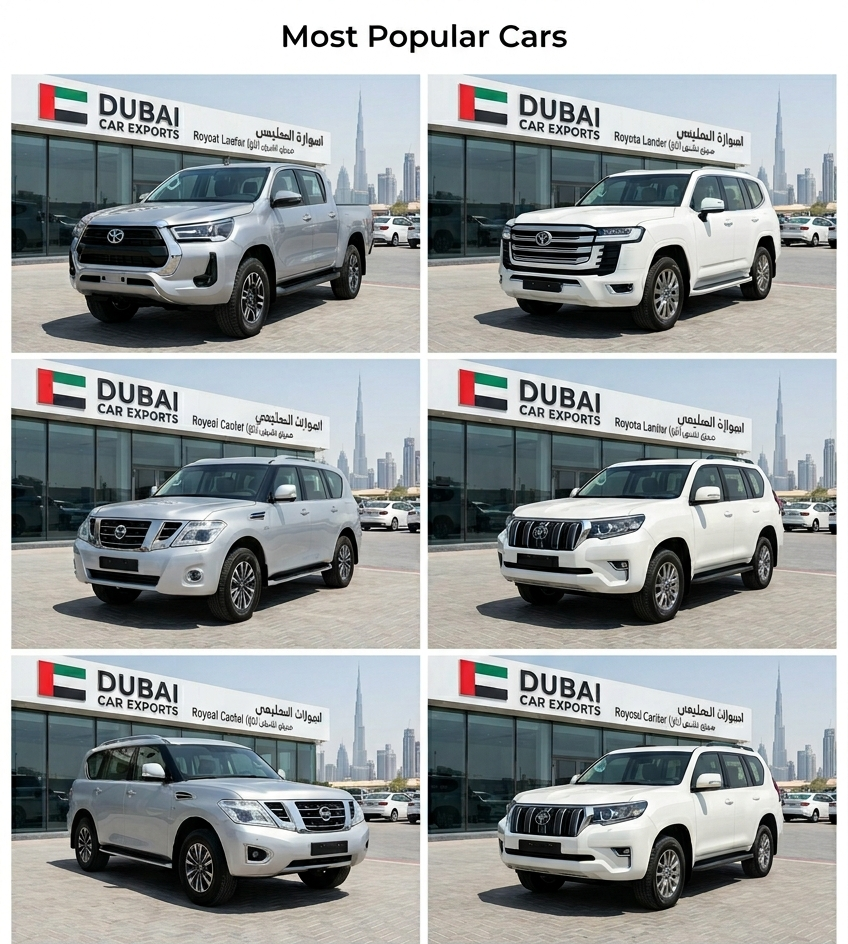
Certain cars sell better in Africa than others. Here is why each one is popular Toyota in Dubai, UAE.
Toyota Hilux — The most popular pickup in Africa. Tough, reliable, spare parts are everywhere. Perfect for both cities and off-road.
Toyota Land Cruiser (200/300 Series) — The king of African roads. High resale value. Loved from Kenya to Nigeria.
Toyota Prado — Slightly smaller than the Land Cruiser but just as trusted. Great for business owners and families.
Nissan Patrol — Massive engine, powerful performance. Very popular in West Africa and East Africa.
Toyota Corolla — Best budget sedan. Low fuel consumption, easy to fix, affordable parts everywhere.
Mitsubishi Pajero — Strong SUV at a lower price than Land Cruiser. Good for rough terrain in Southern Africa.
Toyota Hilux Surf (4Runner) — Medium-sized SUV, popular in Kenya and Uganda.
Pickups are consistently the strongest sellers, and our Dodge RAM trucks in Dubai are available in full GCC spec.
How to Avoid the Most Common Mistakes
A lot of buyers lose money because of simple export mistakes. Here is what to watch out for.
Mistake 1 — Buying a car that is too old. Always check the age limit for your specific country before you pay. If you buy a 2014 car for Kenya in 2026, it will be rejected at the port. That is a very expensive mistake.
Mistake 2 — No original logbook. Some sellers offer only an export plate certificate or a Dubai Police certificate. Kenya and several other countries will not accept this. Always ask: “Do you have the original logbook?”
Mistake 3 — Using an unlicensed clearing agent. Unlicensed agents cut corners. They may give you fake documents or disappear with your money. Always use a registered agent who is a member of your country’s customs agents association.
Mistake 4 — Skipping insurance. Marine insurance on a $15,000 car costs around $150–$200. That is a very small price compared to losing the car at sea. Always ensure.
Mistake 5 — Forgetting port storage fees. Once your car arrives at port, you usually get a few free days. After that, storage charges start. Clear your car as fast as possible, or those fees add up quickly.
Key Facts About Dubai–Africa Car Export
What is the main port for car exports from Dubai? Jebel Ali Port — one of the world’s largest ports, handling the majority of vehicle exports from the UAE.
What is JEVIC? Japan Export Vehicle Inspection Center — a pre-shipment inspection body whose certificate is required for cars going to Kenya and other KEBS-regulated markets.
What is KEBS? Kenya Bureau of Standards — the Kenyan government body that controls which vehicles can enter Kenya. It enforces the 8-year age limit.
What is SON/SONCAP? Standards Organisation of Nigeria — the body that certifies imported goods (including cars) meet Nigerian safety standards. SONCAP approval is required before a car can clear Nigerian customs.
What is RoRo shipping? Roll-on/Roll-off — a shipping method where cars are driven onto a ship using a ramp. It is cheaper than container shipping and is the most common method for used cars going to Africa.
What is a Bill of Lading? A legal document issued by the shipping company. It proves that your car is on board the ship and is needed at the destination port to release the vehicle from customs.
What is CIF value? Cost + Insurance + Freight — the total price of the car including shipping and insurance. Most African countries calculate import duty based on CIF value.
Ready to Export? Here Is How Al Rawnaq Motors Can Help
At Al Rawnaq Motors, we do not just sell cars — we handle the entire journey from Dubai to your door.
Here is what we offer:
- Wide stock of quality used cars ready for export — Toyota, RAM 1500 and TRX in the UAE, Nissan, Mitsubishi, Land Cruiser, Hilux, Prado, and more
- JEVIC and QISJ inspection coordination — we book it, you relax
- Full export documentation — de-registration, export certificate, CoR, Bill of Lading
- Shipping to all major African ports — Mombasa, Dar es Salaam, Lagos, Durban, Tema, and more
- Transparent pricing — no hidden fees, no surprises
- After-sales support — we answer your calls even after the car is shipped
📞 Contact Al Rawnaq Motors Today
Whether you are buying one car for personal use or 20 cars for your dealership, we are ready to help.
Frequently Asked Questions (FAQ)
Q: What is the cheapest way to ship a used car from Dubai to Africa?
A: RoRo (Roll-on/Roll-off) shipping is the cheapest method, costing $800–$1,800 depending on the destination port.
Q: How long does shipping from Dubai to Mombasa take?
A: About 7–10 days via RoRo from Jebel Ali Port to Mombasa Port.
Q: What is the age limit for cars going to Kenya in 2026?
A: From January 1, 2026, Kenya only allows cars registered from January 1, 2019 or later — that is an 8-year age limit.
Q: Does Nigeria accept right-hand drive cars from Dubai?
A: No. Nigeria only allows left-hand drive (LHD) vehicles.
Q: What is SONCAP and do I need it for Nigeria?
A: SONCAP is the Standards Organisation of Nigeria Certificate. Yes, it is required for all vehicles imported into Nigeria.